ThingsFlow
Open industrial IoT middleware for event-driven telemetry, digital twins, data-plane alarms, and optional ThingsBoard UI compatibility.
ThingsFlow follows the modular IoT middleware philosophy of projects such as Mainflux: protocols, identity, message flow, storage, and management APIs have clear boundaries. Its product shape is different. ThingsFlow keeps the useful ThingsBoard operator experience, but replaces the heavy telemetry path with a NATS-first data plane made from small OSS components.
What Makes ThingsFlow Different
- ThingsBoard UI without the ThingsBoard monolith. The Angular UI can be used as a compatibility console, while Flow Core owns the API/control plane.
- NATS as more than a broker. JetStream is the event spine and NATS KV is the authoritative latest/twin hot-state store used by dashboard hydration.
- Flow Core is outside telemetry ingest. It manages users, tenants, devices, credentials, topology, dashboards, alarms API, audit, and compatibility reads.
- Bento keeps the flow declarative. HTTP normalization, latest writes, GreptimeDB history, and alarm-intent detection are handled with standard Bento pipelines instead of custom services per hop.
- Postgres stays operational. It stores metadata, topology, dashboards, alarm lifecycle, users, tenants, audit, and backups; it is not the hot latest telemetry sink.
- GreptimeDB owns time-series history by default. Historical telemetry, chart windows, analytics, and future ML feature extraction read from the time-series store. QuestDB remains an optional backend.
Runtime In One Page
flowchart LR
    classDef edge fill:#e8f4fd,stroke:#2196f3,color:#0d47a1
    classDef bus fill:#fff8e1,stroke:#ffa000,color:#e65100
    classDef proc fill:#f3e5f5,stroke:#8e24aa,color:#4a148c
    classDef store fill:#e8f5e9,stroke:#43a047,color:#1b5e20
    classDef core fill:#eceff1,stroke:#546e7a,color:#263238

    MQTT["MQTT devices"]:::edge --> RMQTT["RMQTT JWT edge"]:::edge
    HTTPD["HTTP devices"]:::edge --> Envoy["Envoy JWT gateway"]:::edge --> HB["Bento http-ingest"]:::proc

    RMQTT --> JS[("NATS JetStream<br/>raw telemetry")]:::bus
    HB --> JS

    JS --> LKV["latest materializer"]:::proc --> KV[("NATS KV twin_state")]:::store
    JS --> HIST["history materializer"]:::proc --> GT[("GreptimeDB history")]:::store
    JS --> AD["alarm detector"]:::proc --> AM["alarm-materializer"]:::proc --> PG[("Postgres<br/>alarm lifecycle")]:::store

    OPS["Operators / APIs /<br/>optional ThingsBoard UI"]:::core --> FC["Flow Core"]:::core
    FC --> PG
    FC --> KV
    FC --> GT
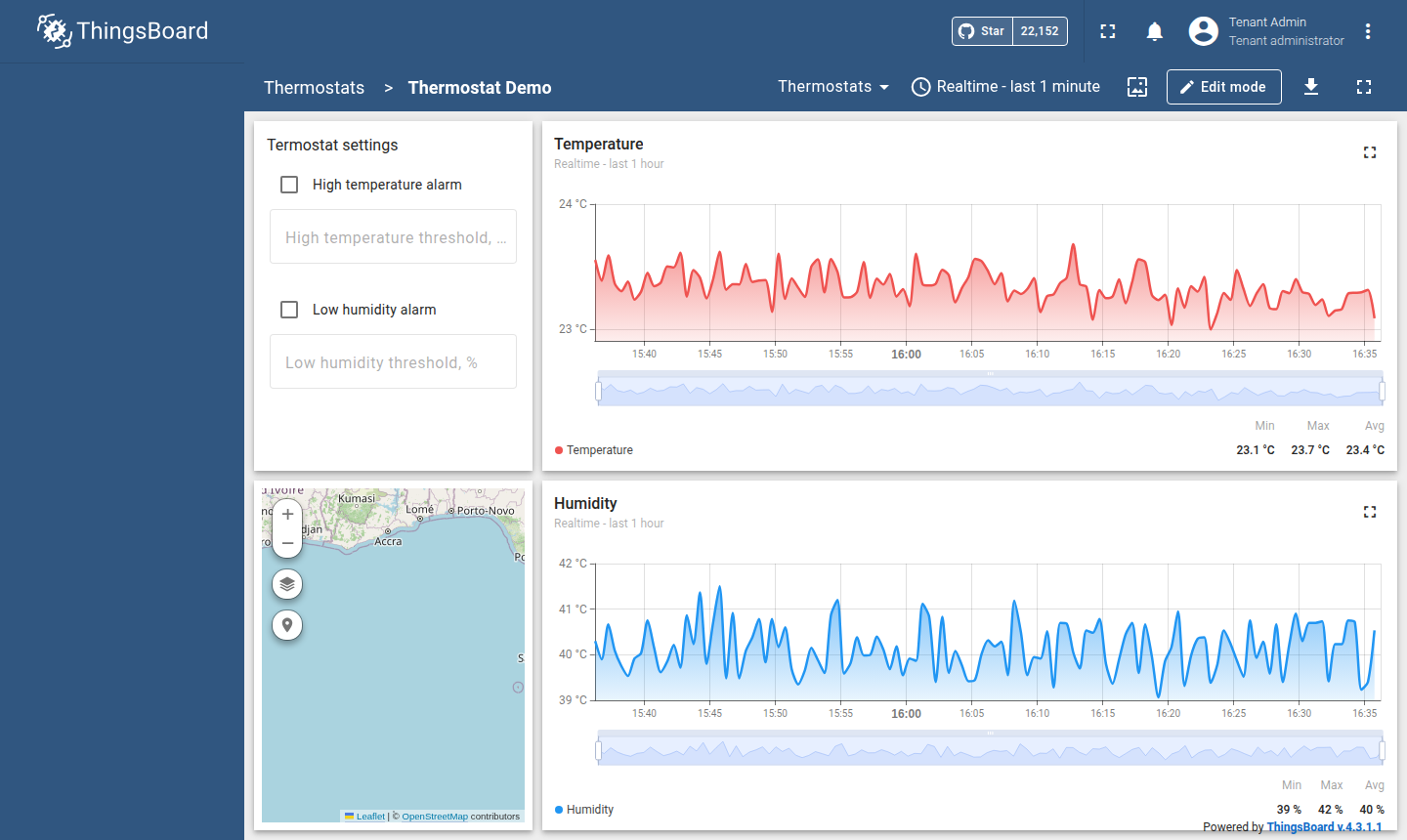
Live telemetry from the demo simulator, rendered by the optional ThingsBoard UI over Flow Core APIs:
Core Modules
| Module | Purpose |
|---|---|
| Flow Core | Go control plane and compatibility API. |
| Data plane | RMQTT, Envoy, Bento, NATS, NATS KV, GreptimeDB, and alarm materialization. |
| Things | Digital twin representation for devices and assets. |
| ThingsBoard UI adapter | Optional compatibility console over Flow Core APIs. |
Documentation Map
Start with the platform shape:
- Getting Started: local compose, Helm install, smoke tests, and default credentials.
- Install: the full Kubernetes install path, production mode, secrets, and OIDC.
- Architecture: component map, control/data-plane split, storage ownership, and scaling boundary.
- Roadmap: which storage and streaming backends are supported today, and which are planned.
- Release: product identity, pilot gates, publication, and OSS release rules.
Understand the domain model:
- Digital Twin: twin model, registry, topology, and twin API.
Follow the messaging path:
- Data Plane: MQTT/HTTP ingress, NATS subjects, Bento materializers, NATS KV latest state, GreptimeDB history, alarm intents, replay, DLQ, and lag checks.
- Edge Gateway: running the field gateway against a remote ThingsFlow endpoint, and the multi-circuit metering pattern.
Operate and secure it:
- API Reference: OpenAPI contract, UI-independent APIs, provisioning, OIDC broker, and UI compatibility contract.
- Device SDK: Python SDK for provisioning, MQTT/HTTP telemetry, and Device JWT renewal.
- MQTT Device Auth: the device-side contract — getting a Device JWT, connecting over TLS, topics, ACLs, and refresh.
- UI Contract Coverage: how ThingsBoard UI compatibility is measured and enforced (373 endpoints, zero silent gaps).
- Security: trust boundaries, key custody, and production checklist.
- Operations: public access, logs, backups, observability, controlled pilot runbook, resource planning, and ThingsFlow vs ThingsBoard Classic benchmark methodology.
Validate a release:
- Demo Profile: dashboards, demo devices, topology, and the telemetry simulator.
- Release: controlled industrial pilot gates, public artifact boundary, and publishing checklist.
Current Status
ThingsFlow is an open-source release candidate for controlled industrial pilots. Use Release as the release boundary before real customer or industrial deployments.