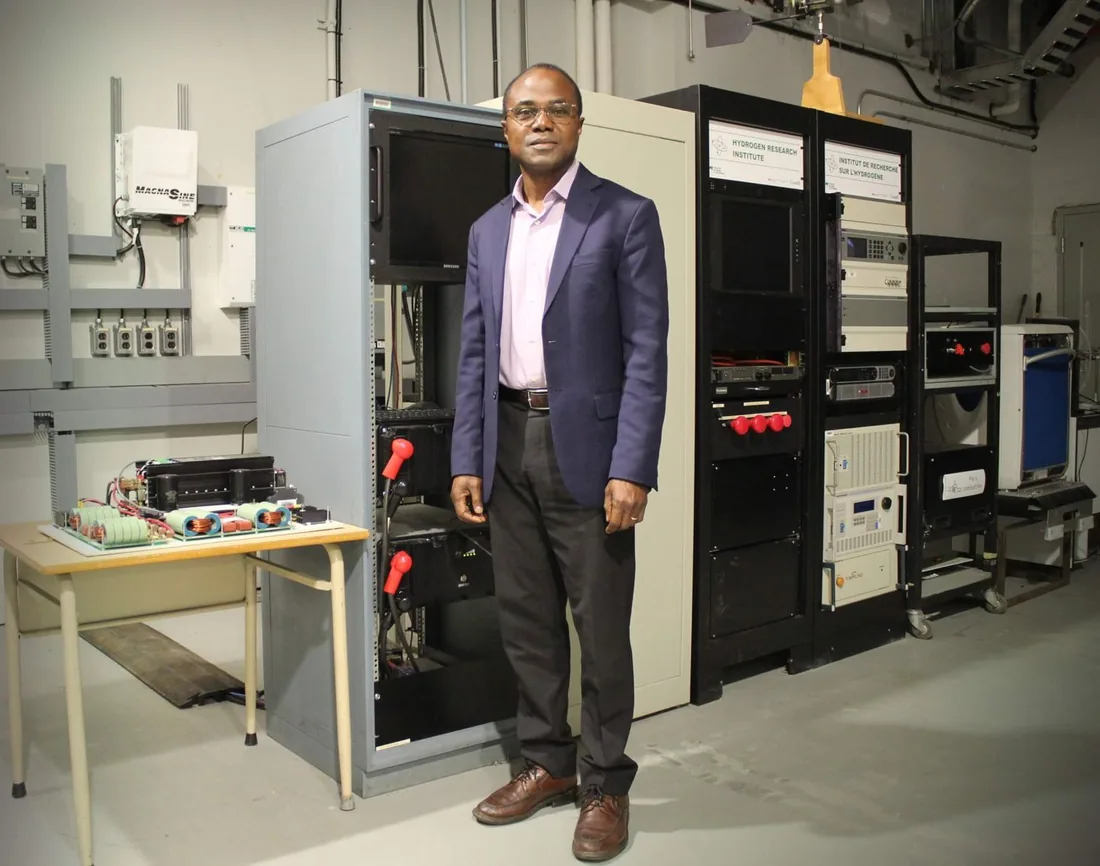
The laboratory
A centre of innovation and exploration at the heart of the Hydrogen Research Institute, where a multidisciplinary team designs tomorrow's intelligent energy solutions.
LIREI brings together professors, research professionals and graduate students around a shared mission: proposing solutions for intelligent energy management, from the power grid to buildings and vehicles. Our work combines optimization, machine learning, modeling and experimentation on real-world data.
Our history
The Hydrogen Research Institute (IRH) at UQTR was publicly inaugurated in 1996. Three years later, in 1999, LIREI was created as a multidisciplinary team within the Institute, with the mission of proposing solutions to manage energy intelligently.
Today, the laboratory pursues its activities in Trois-Rivières and is preparing to move into the new research facilities of UQTR's Pellerin-Marmen building.
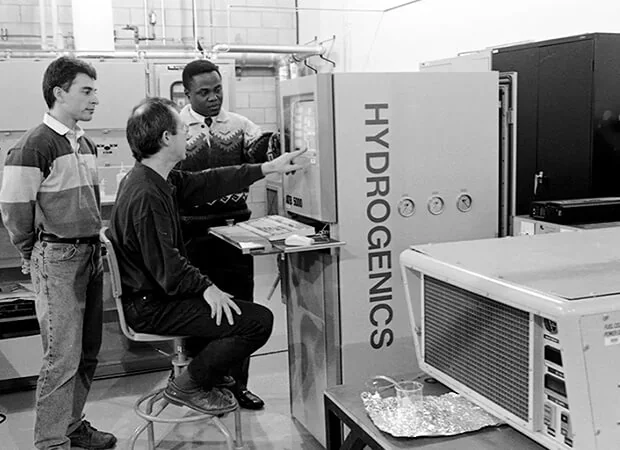
Thirty years of research, reconstructed from the lab's publications, defended theses and major agreements.
- 1996
The IRH is inaugurated
UQTR's Hydrogen Research Institute is publicly inaugurated.
- 1999
LIREI is founded
The laboratory is created as a multidisciplinary team within the IRH, with the mission of proposing solutions to manage energy intelligently.
- 2000-2011
Hydrogen and remote sites
Early work centres on standalone renewable systems coupled with hydrogen: electrolyzers, fuel cells and storage for remote sites. More than half the period's publications deal with hydrogen.
- 2012
The lab's first doctorate
Alben Cardenas Gonzalez defends a thesis on integrating decentralized energy sources into the local grid. He is now a professor at UQTR.
- 2012-2017
Transport electrification
Energy management for electric and fuel-cell vehicles joins the agenda, accounting for over a third of the period's publications.
- 2017
An experimental apartment
The lab commissions an instrumented apartment — communicating thermostats and smart loads — to test, model and optimize residential energy under real conditions.
- 2018-2021
The turn to residential buildings
Demand forecasting, thermal storage, non-intrusive load monitoring and occupant-behaviour modelling become the core of the work: residential rises to 41% of publications.
- 2019
First Hydro-Québec Research Chair
Creation of the Hydro-Québec Research Chair on Transactive Management of Residential Power and Energy Demand, held by Professor Kodjo Agbossou.
- 2023
Alliance program 2023-2028
Launch of the research program on transactive flexibility management with Hydro-Québec's LTE/IREQ and Polytechnique Montréal, backed by NSERC, Mitacs and four industrial partners.
- 2024
A second Chair, broader in scope
The chair is renewed for five years ($3.28M) and becomes the Hydro-Québec Research Chair on Transactive Management of Electrical Energy. It adopts an open intellectual-property approach: results, including code, are released freely.
- 2022-2026
Transactive energy and flexibility markets
Market mechanisms, multi-agent coordination and machine learning now dominate — 35% of recent publications address transactive energy and markets — extending to greenhouses and remote communities.
Our research programs
Our activities are organized around three major programs that structure the laboratory's doctoral projects and collaborations.
Energy flexibility
2023-2028 research program with Hydro-Québec's LTE/IREQ and Polytechnique Montréal: unlocking customer energy flexibility through local energy service markets and hierarchical distribution grid management.
Quebec greenhouses
Program targeting greenhouse energy efficiency and yield in northern climates: predictive energy and climate management, robustness to uncertainty and intelligent anomaly diagnosis.
Remote communities
Program on microgrids for remote communities and sites: replacing diesel with hybrid renewable systems and storage, reliable even under extreme northern conditions.
Continue
Join the laboratory
LIREI is always looking for motivated graduate students interested in intelligent energy management.